

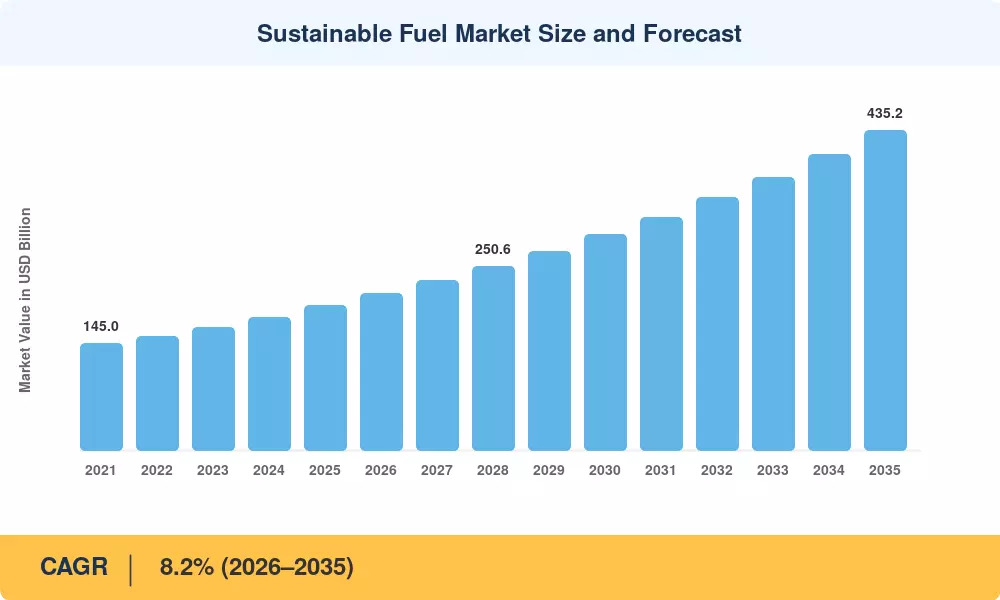
Sustainable Fuel Market Projected to Reach USD 435.2 Billion by 2035, Growing at 8.2% CAGR
Sustainable Fuel Market
Sustainable Fuel Market is projected to reach USD 435.2 Billion, at a 8.2% CAGR by 2035
As Per the MRFR Analysis, Sustainable Fuel Market is projected to reach USD 435.2 Billion, at a 8.2% CAGR by driving industry size, share, top company Analysis, trends and forecast report to 2035”
NEW YORK, NY, UNITED STATES, August 24, 2026 /EINPresswire.com/ -- As Per the MRFR Analysis, Sustainable Fuel Market is projected to reach USD 435.2 Billion, at a 8.2% CAGR by driving industry size, share, top company Analysis, segments research, trends and forecast report to 2035.— Prashant Hake
Market Overview
The Sustainable Fuel Market encompasses low-carbon alternatives to conventional fossil fuels, including biodiesel, renewable diesel (HVO), bioethanol, sustainable aviation fuel (SAF), bio-LNG/bio-CNG, and e-fuels (synthetic). These fuels are produced from renewable feedstocks such as waste oils, agricultural residues, energy crops, municipal solid waste, and novel sources like algae. The market serves road transport, aviation, maritime, industrial, and power generation applications, providing drop-in solutions that are compatible with existing infrastructure while significantly reducing lifecycle greenhouse gas emissions.
Two catalysts are driving this acceleration: the European Union's ReFuelEU Aviation regulation mandating escalating blending quotas through 2050 [1] and the U.S. Inflation Reduction Act's $1.25-per-gallon Sustainable Aviation Fuel (SAF) blender's tax credit, which alone mobilized over USD 4.5 billion in private refinery investment commitments between 2023 and 2025 [2]. The Sustainable Fuel Market stands at the intersection of energy security and climate policy, as decarbonization timelines compress across aviation, maritime, and heavy road transport. Global investment in sustainable fuel production capacity reached approximately USD 78 billion in 2024, with a rising share flowing to next-generation pathways like alcohol-to-jet and power-to-liquid [5][9].
A fundamental technology shift is reshaping the Sustainable Fuel Market. Legacy petroleum refining assets are being retrofitted into hydroprocessed esters and fatty acids (HEFA) and Fischer-Tropsch synthesis facilities. Neste's Singapore expansion — a USD 1.9 billion project completed in 2023 — added 1.3 million tonnes of renewable product capacity, signaling the scale of capital now flowing into drop-in fuel pathways [3]. The technology transition involves displacing unabated fossil-derived fuels with biogenic, waste-derived, and power-to-liquid alternatives, with producers investing in alcohol-to-jet, gasification, and electrolysis-based pathways to achieve deeper carbon reductions.
Get Free Sample Report for Detailed Market Insights:
https://www.marketresearchfuture.com/sample_request/28959
Market Segmentation
By Fuel Type
The Sustainable Fuel Market is segmented into Biodiesel & Renewable Diesel (HVO), Bioethanol, Sustainable Aviation Fuel (SAF), Bio-LNG / Bio-CNG, E-Fuels (Synthetic), and Other Sustainable Fuels. Biodiesel and renewable diesel account for roughly 38% of the market, driven by mature feedstock supply chains and drop-in compatibility with existing diesel infrastructure [3]. Renewable diesel's premium pricing over conventional FAME biodiesel reflects its superior cold-flow properties and compatibility with existing fuel-quality standards, with Neste, TotalEnergies, and Diamond Green Diesel collectively operating over 6 million tonnes of annual HVO capacity [3].
SAF is the fastest-growing fuel segment with a projected CAGR of 14.6% through 2035, reflecting regulatory mandates and airline offtake agreements [9]. Global SAF production reached approximately 1.5 million tonnes in 2024—less than 0.3% of total jet fuel demand—but committed capacity additions across HEFA, AtJ, and Fischer-Tropsch pathways target 10 million tonnes by 2030 [9]. E-fuels and synthetic pathways represent an estimated USD 13.8 billion opportunity by 2035 as electrolyzer costs continue to decline [13]. Bio-LNG and bio-CNG serve maritime and heavy-duty trucking decarbonization, valued at approximately USD 19.8 billion in 2025 [11].
By Application
The Sustainable Fuel Market serves Road Transport, Aviation, Maritime, Industrial / Power Generation, and Other Applications. Road transport absorbs the largest share of sustainable fuel volumes at 52%, although this share is expected to contract as aviation and maritime mandates accelerate [5]. The aviation sector within the market is forecast to grow at a CAGR of 13.9%, propelled by ICAO's CORSIA framework and national blending mandates, with over 100 offtake agreements signed between 2022 and 2025 representing cumulative committed volumes exceeding 25 million tonnes [9]. Maritime applications, driven by IMO's 2023 revised GHG strategy targeting a 20% reduction in shipping emissions by 2030, represent a significant growth opportunity for bio-LNG and bio-methanol bunkering. Industrial and power generation applications support co-firing mandates and industrial heat decarbonization.
By Feedstock
The Sustainable Fuel Market utilizes Waste Oils & Fats (UCO, Tallow), Agricultural Residues, Energy Crops, Municipal Solid Waste, Algae & Novel Sources, and Other Feedstocks. Waste oils and fats anchor the current feedstock supply at roughly 30% share, given their low cost and favourable lifecycle emissions profiles under RED III. However, global UCO collection volumes are estimated at roughly 10 million tonnes annually, yet projected HEFA production capacity alone will require more than 25 million tonnes of eligible feedstocks by 2030. Agricultural residues and municipal solid waste represent the fastest-expanding feedstock categories at CAGRs of 9.5% and 11.3% respectively, driven by cellulosic ethanol and waste-to-fuel gasification projects gaining regulatory support [8]. Energy crops, including sugarcane ethanol in Brazil and corn ethanol in the U.S., account for approximately USD 35.6 billion in 2025 .
By Region
Europe holds an estimated 38% revenue share, the largest of any region in the Sustainable Fuel Market. North America contributes approximately USD 55.4 billion in 2025 revenue, supported by state-level LCFS programmes and federal blender credits. Asia-Pacific records the highest regional CAGR at 10.4%, with India and Japan as primary growth engines. South America and the Middle East & Africa represent smaller but strategically important markets, driven by sugarcane ethanol production and green hydrogen export ambitions respectively.
You can buy this market report at:
https://www.marketresearchfuture.com/checkout?currency=one_user-USD&report_id=28959
Regional Analysis
Europe
Europe commands the dominant share of the Sustainable Fuel Market at roughly 38% of global revenue, propelled by the EU Renewable Energy Directive III (RED III) targets. Germany leads with approximately 24% of regional share, driven by a national power-to-liquid roadmap committing EUR 1.8 billion in federal funding through 2028 [6]. France follows with an 8.8% CAGR through 2035, supported by domestic SAF blending mandates and TotalEnergies' capacity expansion. The United Kingdom contributes approximately USD 7.2 billion in 2025, with its Jet Zero Strategy targeting 10% SAF use by 2030 and establishing a dedicated SAF clearing house [1]. The Netherlands represents roughly 16% of regional share, anchored by Neste's Rotterdam refinery—the world's largest renewable diesel plant—and major HVO refining hub status [3]. The Rest of Europe, including Nordic countries with biofuel heritage, accounts for approximately 28% of regional share through RED III transposition [6].
North America
North America holds the second-largest share of the Sustainable Fuel Market at approximately 28%, anchored by California's Low Carbon Standard and federal tax incentives. The United States dominates with roughly 82% of regional share, driven by the IRA §45Z credit and California LCFS, which generated over 25 million LCFS credits in 2024 [8]. Refinery conversions along the Gulf Coast and West Coast—including the former Phillips 66 Rodeo facility now producing 100% renewable fuels—illustrate the industry's pivot from petroleum refining to sustainable feedstock processing [2]. Canada follows with a 9.3% CAGR, supported by Clean Fuel Regulations effective since 2023 that impose lifecycle carbon intensity reduction requirements [21]. Mexico represents a smaller market with biodiesel blending pilot programmes [21].
Asia-Pacific
Asia-Pacific is the fastest-growing region in the Sustainable Fuel Market with a projected CAGR of 10.4%, reflecting aggressive government mandates and abundant biomass feedstock. India leads with a 12.1% CAGR, with its ethanol blending programme achieving the E20 target ahead of schedule and a production-linked incentive scheme worth INR 18,000 crore targeting second-generation ethanol and compressed biogas [7]. China accounts for roughly 34% of regional share, leveraging waste-oil collection infrastructure and biodiesel exports. Japan contributes approximately USD 5.8 billion in 2025, with a SAF commercialization roadmap targeting 10% replacement of jet fuel consumed domestically by 2030 [10]. South Korea follows with a 10.8% CAGR, driven by its Hydrogen Economy Roadmap and SAF mandate effective from 2027. The Rest of Asia-Pacific, including Southeast Asian countries with palm-residue feedstock advantages, accounts for approximately 18% of regional share.
South America
South America contributes approximately USD 13.8 billion to the Sustainable Fuel Market, with Brazil anchoring regional demand. Brazil accounts for roughly 72% of regional share, producing more than 35 billion litres of sugarcane ethanol annually, with the RenovaBio programme monetizing carbon reductions through tradable CBIOs [20]. Argentina follows with a 7.9% CAGR, driven by soybean-based biodiesel expansion and exports of approximately 1.8 million tonnes in 2024. The Rest of South America represents emerging palm-oil and forestry-residue programmes.
Middle East & Africa
The Middle East & Africa region is transitioning from fossil-fuel exporter to sustainable-fuel producer, with a projected CAGR of 7.5% through 2035. The UAE leads with approximately 38% of regional share, driven by Masdar green hydrogen projects and SAF trials, with over USD 2 billion committed to green hydrogen electrolyzer capacity [22]. Saudi Arabia follows with an 8.1% CAGR, anchored by the NEOM green hydrogen and synthetic fuel ambitions targeting 600 tonnes per day of green hydrogen production by 2026 [22]. South Africa represents approximately USD 1.2 billion in 2025, with Sasol's pivot from gas-to-liquids to sustainable feedstock. The Rest of MEA accounts for roughly 22% of regional share through nascent biofuel programmes across East Africa.
Competitive Landscape / Key Players
The Sustainable Fuel Market is moderately concentrated, with the top five producers accounting for roughly 32–38% of global revenue [14]. Key players include Neste, TotalEnergies, bp, Shell, Gevo, LanzaTech, World Energy, Chevron (REG), Cepsa, and Preem [14].
Neste leads with an estimated 8–11% revenue share, offering renewable diesel, SAF (HEFA), and renewable feedstock trading as the largest pure-play renewable fuels producer with a global refinery network [3]. TotalEnergies follows with 5–8% share, providing HVO, SAF, and bio-LNG bunkering as an integrated major pivoting its refining portfolio to renewables. bp holds 4–7% share, focusing on renewable diesel at Cherry Point and SAF partnerships with a refinery conversion strategy and AI-enabled process optimization [24]. Shell commands 4–6% share, offering biofuels, SAF blending, and e-fuel pilot projects with a broad portfolio across multiple sustainable fuel pathways. Gevo holds 2–4% share, specializing in alcohol-to-jet SAF and isobutanol as a technology-led pure-play targeting net-zero SAF [19]. LanzaTech follows with 2–3% share, offering gas-fermentation ethanol and CarbonSmart products with a waste-gas-to-fuel platform and licensing model [18].
Strategic developments in the industry include the European Commission's March 2024 finalization of implementing rules for ReFuelEU Aviation, specifying SAF blending quotas, reporting mechanisms, and penalty structures effective from January 2025 [1]. India's Ministry of Petroleum announced a production-linked incentive scheme of INR 18,000 crore for second-generation ethanol and compressed biogas in February 2025, supporting the Sustainable Fuel Market expansion in Asia-Pacific [7]. bp & C3.ai reported a 6–8% renewable diesel yield improvement at bp's Cherry Point refinery through AI-driven catalyst and process optimization, demonstrating scalable digital gains in sustainable fuel production [24].
Latest Industry News & Developments
European Commission (March 2024): Finalized implementing rules for ReFuelEU Aviation, specifying SAF blending quotas, reporting mechanisms, and penalty structures effective from January 2025 [1].
India Ministry of Petroleum (February 2025): Announced a production-linked incentive scheme of INR 18,000 crore for second-generation ethanol and compressed biogas, supporting the Sustainable Fuel Market expansion in Asia-Pacific [7].
bp & C3.ai (April 2025): Reported a 6–8% renewable diesel yield improvement at bp's Cherry Point refinery through AI-driven catalyst and process optimization, demonstrating scalable digital gains in sustainable fuel production [24].
Neste (2023): Completed its Singapore expansion—a USD 1.9 billion project—adding 1.3 million tonnes of renewable product capacity, signaling the scale of capital flowing into drop-in fuel pathways [3].
Market Challenges & Opportunities
Challenges
The Sustainable Fuel Market faces several notable challenges. Feedstock supply constraints represent the single largest structural challenge, with global UCO collection volumes estimated at roughly 10 million tonnes annually, yet projected HEFA production capacity alone will require more than 25 million tonnes of eligible feedstocks by 2030 [12]. Competition among biodiesel, renewable diesel, and SAF producers for the same waste-oil supply has driven UCO spot prices up nearly 35% since 2022 [12].
High production cost premium over fossil fuels remains a significant barrier, with SAF currently trading at a 2–5× cost premium over conventional Jet A-1, while e-fuels produced via direct air capture and electrolysis can exceed USD 5 per litre [16]. Infrastructure and logistics gaps, particularly in emerging economies, restrict sustainable fuel penetration outside Western markets, with the anticipated cumulative investment of USD 35 billion through 2035 necessary to upgrade global infrastructure [17]. Policy uncertainty and subsidy phase-out risk, along with certification and sustainability verification complexity, further challenge market growth.
Opportunities
Significant opportunities exist in the Sustainable Fuel Market. SAF scale-up through alcohol-to-jet and Fischer-Tropsch pathways presents a transformative opportunity, with AtJ capacity expected to quadruple by 2030 as LanzaJet's Freedom Pines facility demonstrates cost-competitiveness at USD 3.50 per gallon [19]. Maritime decarbonization and bio-LNG bunkering offer a substantial addressable opportunity, with the IMO's 2023 revised GHG strategy targeting a 20% reduction in shipping emissions by 2030 relative to 2008 and net-zero by 2050 [11].
Emerging-market biofuel production in Southeast Asia and Latin America offers greenfield opportunities, with Brazil's RenovaBio program generating more than 36 million decarbonization credits (CBIOs) in 2024 [20]. Digital certification and carbon-credit monetization, including blockchain-based chain-of-custody platforms like RSB's book-and-claim system, create new revenue streams by enabling airlines to purchase verified carbon reductions independent of supply logistics [18]. Green hydrogen integration for power-to-liquid fuels represents a long-term growth vector, with electrolyzer installed capacity forecast to reach 134 GW globally by 2030 [13].
To explore more market insights, visit us at:
https://www.marketresearchfuture.com/reports/sustainable-fuel-market-28959
Final Market Summary
The Sustainable Fuel Market is poised for robust growth, projected to expand from USD 214.0 billion in 2026 to USD 435.2 billion by 2035, at a CAGR of 8.2%. This expansion is fundamentally underpinned by regulatory blending mandates, aviation decarbonization and airline offtake agreements, and tax incentives that convert voluntary commitments into guaranteed demand. Europe maintains its dominant position, while Asia-Pacific emerges as the fastest-growing region, driven by ethanol blending programmes, SAF roadmaps, and green hydrogen integration. Technological innovation, including SAF scale-up through alcohol-to-jet and Fischer-Tropsch pathways, feedstock diversification, and digital certification platforms, is reshaping the competitive landscape, enabling operators to achieve deeper carbon reductions and unlock new value streams. The market's long-term potential remains exceptionally strong, supported by the convergence of decarbonization policy, corporate ESG commitments, and emerging opportunities in maritime decarbonization and emerging-market biofuel production, ensuring sustainable fuels' critical role as the primary decarbonization lever for hard-to-abate transport sectors through 2035 and beyond.
More Related Reports from MRFR Library:
Intelligent Motor Controller Market: https://www.marketresearchfuture.com/reports/intelligent-motor-controller-market-7653
Modular Substation Market: https://www.marketresearchfuture.com/reports/modular-substation-market-7657
Marine Diesel Engine Market: https://www.marketresearchfuture.com/reports/marine-diesel-engine-market-7662
Hydraulic Pumps Market: https://www.marketresearchfuture.com/reports/hydraulic-pumps-market-7736
HVAC Motors Market: https://www.marketresearchfuture.com/reports/hvac-motors-market-7739
LNG Bunkering Market: https://www.marketresearchfuture.com/reports/lng-bunkering-market-7741
Hybrid Switchgear Market: https://www.marketresearchfuture.com/reports/hybrid-switchgear-market-7924
Electric Fuse Market: https://www.marketresearchfuture.com/reports/electric-fuse-market-7934
Hydropower Turbine Market: https://www.marketresearchfuture.com/reports/hydropower-turbine-market-8224
Power Plant Control System Market: https://www.marketresearchfuture.com/reports/power-plant-control-system-market-8350
Larry Wilson
WantStats Research And Media Pvt. Ltd.
+ +1 855-661-4441
email us here
Visit us on social media:
LinkedIn
Facebook
YouTube
X
Legal Disclaimer:
EIN Presswire provides this news content "as is" without warranty of any kind. We do not accept any responsibility or liability for the accuracy, content, images, videos, licenses, completeness, legality, or reliability of the information contained in this article. If you have any complaints or copyright issues related to this article, kindly contact the author above.
